
ABOUT THE AUTHOR
Markku Riihimäki
Forecon, Finland
Markku Riihimäki is a leading expert and CEO of Forecon Ltd, specializing in construction materials market forecasting and business intelligence for the building sector. With an M.Sc. (Tech) and decades of experience, he is recognized for his research-driven insights into construction product markets, both in Finland and across Europe. As a member of the EUROCONSTRUCT network, he plays a key role in international market outlooks, supporting strategic planning for construction industry stakeholders, authorities, and investors.
Europe’s construction sector continues to recover but more slowly than expected.
Helsinki, Finland – June 5, 2026. –The outlook for the European construction sector remains cautiously positive, but growth is forecast to be slower than previously expected. Since the EUROCONSTRUCT forecast in November 2025, the operating environment for construction has changed in many ways. War of Iran and the situation in the Strait of Hormuz has a significant impact on the global economy, energy prices, inflation and interest rate trends – all factors that weigh heavily on demand in the construction sector. Consumer and business confidence in the future has fallen, and economic forecasts have been revised downwards in several countries over the spring. It is likely that this uncertainty will continue.
In the EUROCONSTRUCT countries (EC-19), gross domestic product grew by 1.5% in 2025. Between 2026 and 2028, GDP is forecast to grow by an average of 1.2% per year. Growth in 2026 will remain weaker than previously estimated, at 1.1%; in 2027, it is set to be 1.3%. However, none of the EC-19 countries is forecasting negative economic growth.
Construction growth in 2026 is lower than previously forecast
Total construction output in the EC-19 countries grew by just 0.2% in 2025. Growth was slightly weaker than the November 2025 forecast, which had estimated growth at 0.3%. In 2026, construction is forecast to grow by 2.0%, whereas six months ago the expectation was 2.4%. The growth forecasts for 2027 and 2028 remain unchanged at 2.2% and 1.9% respectively.
Overall, construction output in the EC-19 area has developed fairly steadily in recent years, although 2023 and 2024 were years of decline. During these two years, output fell by just over 3% in total. The growth forecast for 2026–2028 is just over 2% in total, indicating that the recovery will continue but at a moderate pace.
Significant differences between sectors – civil engineering remains the strongest
The various sectors of construction developed very differently between 2023 and 2025: residential output reduced sharply, non-residential construction remained unchanged overall, while civil engineering grew. During the forecast period of 2026–2028, all sectors are expected to grow.
In recent years, fluctuations in new construction have been significantly greater than those in renovation. Between 2023 and 2025, the output of new building construction fell, while building renovation only slightly reduced. During the period of 2026–2028, the output of new building construction is expected to grow higher than building renovation. The slow growth in renovation is primarily due to weaker consumer confidence due to uncertainty and the limited willingness of households to invest in home improvements.
In civil engineering, both new construction and renovation grew strongly between 2023 and 2025. During the period of 2026–2028, both new construction and renovation are expected to grow on the back of transport investments, energy infrastructure, security and contingency planning needs, adaptation to climate change, and projects supported by EU programmes.
One of the key findings in the new forecast is that the structure of construction growth has changed. New construction and civil engineering are more clearly the drivers of growth than previously, while renovation remains stable but in a phase of slower growth. The counter-cyclical role of building renovation has weakened compared to the years of the energy crisis and the energy efficiency boom, when subsidy schemes and regulation boosted the market more strongly. Economic and consumer uncertainty is now weighing on renovation, while investment is benefiting new construction.
Figure 1: GDP and Construction Output
Year-to-year change, in % in real terms
S: EUROCONSTRUCT, June 2026.
Developments remain highly varied by country
Construction trends across different parts of Europe continue to diverge significantly. In the Nordic countries and Austria, total construction output fell sharply in 2023 and 2024 and will not return to 2022 levels during the period. In these countries, the primary underlying factor is a sharp collapse in new residential construction.
The strongest growth in construction between 2025 and 2028 is forecast for Ireland, Poland, the UK and Portugal. Growth is weakest in Slovakia, Italy and Belgium. Ireland continues to stand out as the fastest-growing market, thanks to strong public investment and steady demand. Poland is also benefiting from strong medium-term growth, although forecasts have been revised slightly downward. Spain and Portugal, in turn, are benefiting from broad-based growth in both building construction and civil engineering. Germany, France, Austria and Italy continue to suffer from weak housing demand, high costs and limited financing.
Table 1: Evolution of construction output in the EUROCONSTRUCT 19 area
| 2022 | 2023 | 2024 | 2025 | Forecasts | Outlook | ||
|---|---|---|---|---|---|---|---|
| 2026 | 2027 | 2028 | |||||
| Austria | -2,1 | -4,5 | -5,2 | -1,3 | 0,0 | 0,8 | 1,0 |
| Belgium | 0,6 | -1,2 | 0,0 | -0,3 | 1,3 | -0,2 | 0,2 |
| Denmark | 1,4 | -12,0 | -4,3 | 1,2 | 2,0 | 2,9 | 2,3 |
| Finland | -0,4 | -12,4 | -6,2 | 1,0 | 4,7 | 5,5 | -1,0 |
| France | 1,9 | 0,0 | -1,8 | -3,0 | 1,1 | 2,2 | 1,4 |
| Germany | -5,1 | -3,2 | -2,9 | -1,0 | 1,0 | 1,3 | 1,0 |
| Ireland | 3,7 | 7,6 | -4,8 | 11,7 | 5,3 | 5,8 | 6,2 |
| Italy | 12,2 | 3,3 | -1,7 | -2,6 | 1,6 | -0,1 | -0,8 |
| Netherlands | 4,0 | 0,8 | -2,7 | 1,3 | 2,2 | 3,4 | 3,1 |
| Norway | 1,0 | -5,3 | -5,7 | 1,1 | 2,3 | 0,0 | 2,8 |
| Portugal | 1,9 | 5,3 | 4,1 | 6,1 | 4,4 | 3,6 | 3,3 |
| Spain | 3,3 | 2,4 | 2,8 | 4,3 | 3,2 | 2,4 | 1,8 |
| Sweden | -2,1 | -10,7 | -3,0 | 3,2 | 4,0 | 2,4 | 3,8 |
| Switzerland | -6,6 | -0,7 | -1,4 | -0,3 | 1,9 | 1,5 | 1,3 |
| United Kingdom | 6,9 | 0,4 | -0,2 | 1,8 | 2,4 | 4,3 | 5,1 |
| Western Europe (EC-15) | 1,6 | -1,0 | -1,7 | 0,1 | 1,9 | 2,1 | 1,9 |
| Czechia | 1,0 | 1,8 | -1,7 | 4,6 | 2,5 | 2,5 | 2,8 |
| Hungary | 1,3 | -7,6 | -2,7 | 0,5 | -1,5 | 2,4 | 5,0 |
| Poland | 5,5 | 6,4 | -0,9 | 2,2 | 6,4 | 4,9 | 3,1 |
| Slovakia | 0,5 | 5,4 | -5,8 | 1,9 | -2,9 | -1,9 | -0,5 |
| Eastern Europe (EC-4) | 3,3 | 2,8 | -1,7 | 2,5 | 3,6 | 3,5 | 3,1 |
| Euroconstruct Countries (EC-19) | 1,7 | -0,8 | -1,7 | 0,2 | 2,0 | 2,2 | 1,9 |
S: EUROCONSTRUCT, June 2026.
EUROCONSTRUCT forecasts available for purchase
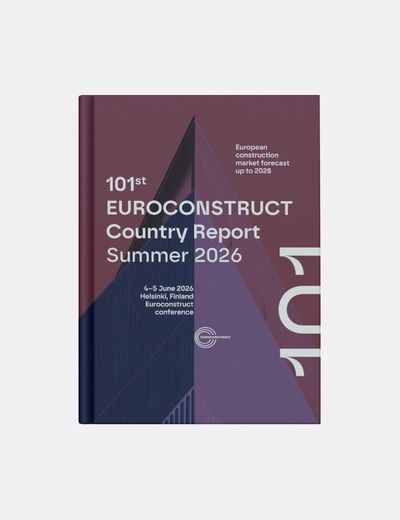
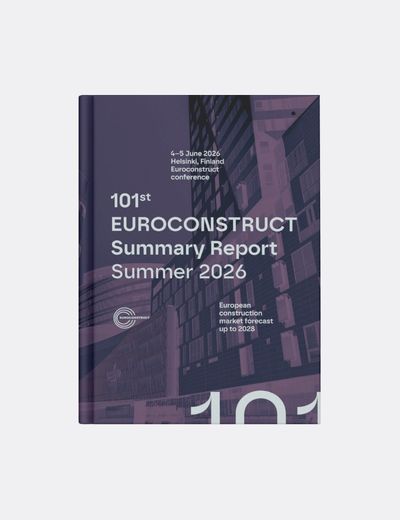
All our analyses and forecasts are published in our reports – the EUROCONSTRUCT Country Report and the EUROCONSTRUCT Summary Report. Read more
About EUROCONSTRUCT
The 101st EUROCONSTRUCT-Conference was held in Helsinki on 5 June 2026, hosted by Forecon Ltd..
EUROCONSTRUCT was founded in 1975 by specialised research organisations from France, Germany, Italy, the Netherlands and the United Kingdom as a study group for construction analysis and forecasting. It has since expanded from this core group to include almost all Western European countries and four Central Eastern European countries. Currently, EUROCONSTRUCT has member institutes in 19 European countries.
The objective of EUROCONSTRUCT is to provide information, analysis and forecasts to decision-makers in the construction sector and other markets related to the construction industry, to enable them to plan their business better and more effectively. The activities of the EUROCONSTRUCT network are also aimed at official institutions such as ministries or agencies, as well as national and international associations.
ABOUT THE AUTHOR
Markku Riihimäki
Forecon, Finland
Markku Riihimäki is a leading expert and CEO of Forecon Ltd, specializing in construction materials market forecasting and business intelligence for the building sector. With an M.Sc. (Tech) and decades of experience, he is recognized for his research-driven insights into construction product markets, both in Finland and across Europe. As a member of the EUROCONSTRUCT network, he plays a key role in international market outlooks, supporting strategic planning for construction industry stakeholders, authorities, and investors.