
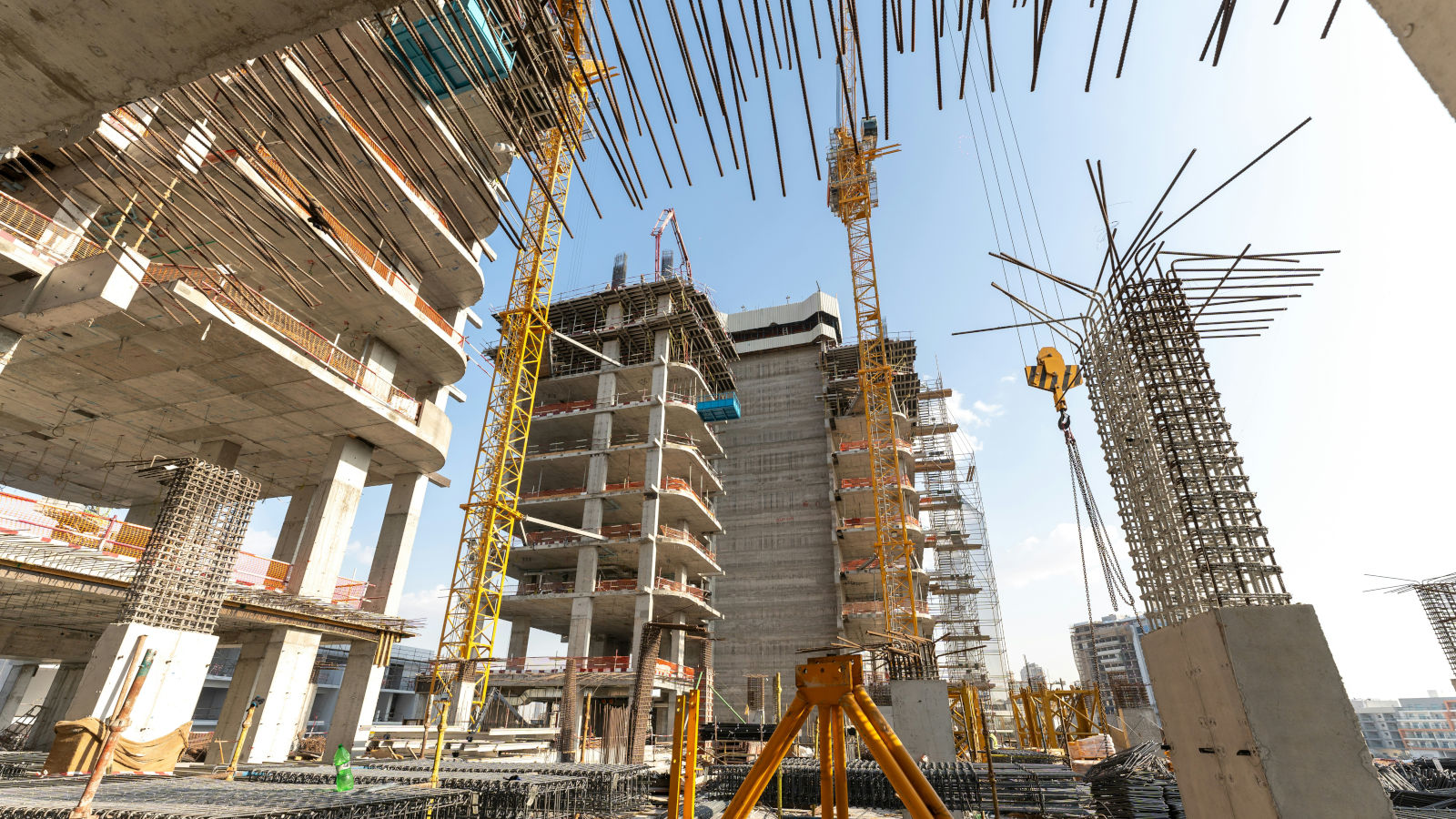
While new residential construction has contracted across much of Europe, Ireland has continued to grow its housing output. The reasons lie less in any single scheme than in a decade of policy persistence.
Across Europe, the post-pandemic period has been difficult for housebuilders. Higher interest rates and construction cost inflation have combined to push new residential construction into decline in the majority of markets. These cyclical pressures have compounded longer-standing constraints on housing delivery across many European markets, including planning and permitting delays, limited land availability and gaps in enabling infrastructure.
The latest EUROCONSTRUCT data (June 2026) shows new residential output falling in 16 of the 19 countries in the Network in 2024, with total housing completions across the network dropping by almost a quarter between 2022 and 2025, from around 1.85 million to 1.42 million homes.
Ireland has moved in the opposite direction. New dwelling completions reached 36,284 in 2025, up 20.4% on the prior year, with apartment completions rising almost 39% to over 12,000. The latest EY Ireland forecasts for EUROCONSTRUCT project completions rising further to 40,000 in 2026, 43,000 in 2027 and 47,000 by 2028.
Ireland has not solved its housing challenge. The Housing Commission estimates a shortfall of between 212,000 and 256,000 homes, and output remains below what is needed to meet demand. But the direction of travel stands out, and it raises a question European policymakers are increasingly asking: what has Ireland done differently?
Five policy levers supporting Ireland’s housing delivery
- Treat housing as national infrastructure. Sustained, multi-year public capital investment has supported social and affordable delivery through weaker market conditions, provided greater certainty to the construction supply chain and reduced sales risk by positioning the State as an anchor purchaser.
- Build dedicated delivery institutions. The Land Development Agency, Home Building Finance Ireland and newer housing-activation structures provide the mandates, capital and coordination needed to unlock public land, finance viable development and progress stalled schemes.
- Mobilise institutional capital within stable rules. Institutional investment has supplied equity for large, high-density apartment developments that traditional lending and owner-occupier sales could not readily support, but must be balanced with affordability, tenure security and appropriate public-interest safeguards.
- Close viability gaps through targeted support. Measures such as Croí Cónaithe (a State fund to bridge the viability gap between the cost of building apartments and the market price for sale to owner-occupiers), reduced VAT on new apartment sales and enhanced corporation tax deductions seek to unlock developments that would otherwise remain unviable. Supports should be transparent, time-limited and conditional on genuine additional supply to limit deadweight and house-price effects.
- Reduce planning friction and support appropriate density. Clearer national standards, predictable consenting routes and greater density near transport can improve development viability, but planning reform must be accompanied by serviced land, infrastructure and adequate design standards if permissions are to translate into completed homes.
Taken together, the five levers show that increasing housing supply requires a coordinated system of long-term funding, capable delivery institutions, private capital, targeted viability support and predictable planning, rather than reliance on any single policy intervention.
1. Treating housing as national infrastructure
The most significant difference is the scale and persistence of state capital investment. Since Rebuilding Ireland in 2016 and through Housing for All in 2021, the Irish Government have kept housing at the top of the capital programme, through economic cycles and changes of government. By 2024, government support for housing had reached 2.3% of GNI*, the highest level in Europe. That commitment has continued: in 2025, government capital spending reached approximately €26.3 billion, of which €6 billion was allocated to housing. The new plan, Delivering Homes, Building Communities 2025–2030, sets an ambition of 300,000 homes by 2030, including 72,000 new-build social homes, and links delivery to a record €275 billion National Development Plan to 2035.
This matters for three reasons. First, state-funded social and affordable delivery is counter-cyclical: it continues when private viability weakens, keeping construction firms and workforces active through downturns. Second, multi-year funding commitments give the supply chain confidence to invest in capacity. Third, the state acts as an anchor purchaser, through local authorities, approved housing bodies and the Land Development Agency, which reduces sales risk on large schemes and improves their bankability.
Many European governments have pulled back from housing capital spending under fiscal pressure. Ireland’s experience suggests that protecting this spend can be an effective lever for stabilising output when markets turn. However, capital allocations should not be treated as a substitute for delivery capacity, where land, infrastructure, procurement or planning constraints remain, additional funding may compete against scarce resources or other national priorities and may ultimately feed through to higher housing prices rather than proportionately higher output.
2. Building a dedicated delivery architecture
Funding alone does not build homes. Ireland has paired investment with institutions designed to turn money into units. The Land Development Agency, established in 2018 and placed on a statutory footing in 2021, was given a mandate to activate public land for affordable housing at scale. Cost rental, introduced under Housing for All, created a new tenure between social housing and the open market, with rents linked to the cost of delivery rather than market rates. Home Building Finance Ireland, also established in 2018, filled a gap in development finance left by the retrenchment of the domestic banks.
That architecture is now maturing into active delivery. Under Delivering Homes, Building Communities, the LDA received an additional €2.5 billion in State equity, bringing total Exchequer support to approximately €8.75 billion. It reports a pipeline of around 27,000 homes across more than 40 sites and aims to deliver approximately 14,000 homes by 2029, with output rising from just under 2,000 homes in 2026 to more than 3,000 a year from 2027. Its Project Tosaigh model, which acquires or forward-funds schemes that have full planning permission but have stalled, acts as a counter-cyclical activation tool: construction of nearly 800 apartments at Richmond Village, Fairview, began in early 2026. A new Housing Activation Office and Housing Infrastructure Investment Fund now coordinate utilities and accelerate serviced land.
For European countries with fragmented delivery systems, a clear, well-capitalised delivery vehicle with a specific mandate can help unlock public land and sustain pipelines in a way that grant programmes alone cannot. Its effectiveness nevertheless depends on governance, access to serviced land and coordination with local authorities and infrastructure providers. Without clear accountability and commercial discipline, an additional institution could add another layer of process, displace rather than supplement existing delivery, or pay above-market prices that are subsequently reflected in rents or sale values.
3. Opening the door to institutional capital
Ireland made a deliberate choice in the decade after the financial crisis to attract institutional investment into residential property. The REIT regime introduced in 2013, the Irish Real Estate Fund framework in 2016, and design guidance that made build-to-rent viable at higher densities all brought new pools of equity into a market that domestic lending could no longer finance alone.
This capital was critical in funding the apartment pipeline, particularly in Dublin, at a time when owner-occupier apartment schemes were rarely viable. It was not without controversy: forward-funding of build-to-rent and bulk purchases of homes generated significant public debate, and later tax and rent measures cooled investor appetite, contributing to the dip in apartment completions in 2024. Policy is now being reset to win that capital back. Rent Pressure Zones were extended nationwide in June 2025, with annual rent increases capped at the lower of 2% or inflation, and from 1 March 2026 landlords can reset rents to market levels at the end of each six-year tenancy where the tenant leaves voluntarily. The transition has had a cost, however: apartment commencements fell to 6,274 units in 2025 while the market awaited the new rules.
The transferable insight is not to rely on institutional capital, but to understand it as a supply tool that needs predictable rules and clear public-interest safeguards. Policy stability matters as much as initial incentives, but stability should not mean insulating investors from all regulatory change. Governments need to balance the cost and availability of capital against affordability, security of tenure and competition for development land and completed homes. Poorly calibrated tax or planning incentives may increase land values or acquisition prices without delivering a commensurate increase in supply, while frequent changes in investment terms can still deter the long-term capital needed for high-density delivery.
4. Closing the viability gap, precisely
Where markets cannot deliver at a price buyers can afford, Ireland has increasingly intervened with targeted, rather than blanket, supports. Croí Cónaithe (Cities), launched in 2022, funds the gap between cost and sale price for owner-occupier apartments, using open-book accounting to ensure the subsidy covers only the shortfall. The Government has stated that the apartments contracted under the scheme would not otherwise have been built. The gap remains wide: a typical two-bedroom apartment in Dublin costs an estimated €550,000–€600,000 to build, well above achievable sale prices. Budget 2026 therefore cut VAT on completed apartment sales from 13.5% to 9% until end-2030 and introduced an additional enhanced corporation tax deduction for qualifying construction costs on schemes of 10 or more apartments, capped at €50,000 per unit.
On the demand side, Help to Buy (2016) and the First Home shared equity scheme (2022) were tied specifically to new-build homes. Supply-linked support of this kind reduces the risk of simply inflating second-hand prices. The temporary waiver of development levies and water connection charges in 2023 lowered upfront costs for builders, and contributed to over 69,000 commencements in 2024 that are now feeding into completions. The expiry of the waiver also shows the cliff-edge risk of time-limited measures: commencements fell to 16,412 in 2025, before rebounding to 8,408 in the first quarter of 2026 alone.
Other markets can learn from both the design and the discipline. Viability supports are most defensible when they are transparent, time-limited and directly conditional on genuinely additional supply. If subsidy levels are capitalised into land prices, or if buyer supports raise purchasing power faster than output can respond, part of the benefit may be captured through higher house prices. Sunset clauses, open-book assessment, price caps and clawback provisions can help limit deadweight and protect value for money.
5. Reducing planning friction and raising density
Ireland’s planning system has long been seen as a constraint on supply, and reform has been gradual rather than complete. Even so, a series of earlier measures has helped. The 2018 Building Height and Apartment Design guidelines allowed greater density in urban areas and near public transport. The Strategic Housing Development process (2017–2021) gave large schemes a direct route to the national planning authority, putting a significant pipeline of permissions in place, though it was ultimately replaced amid judicial review challenges.
Reform has gathered pace since 2025. Revised Apartment Standards (July 2025) reduced minimum unit sizes, for example from 55 sqm to 45 sqm for a one-bed, which is estimated to lower the average cost per apartment by €50,000 to €100,000, though the change is now subject to a judicial review. Residential planning exemptions are being updated under the Planning and Development Act 2024, and the December 2025 Accelerating Infrastructure Action Plan proposes statutory timelines and judicial review reform. The pipeline shows why activation matters: 34,974 homes were granted permission in 2025, up 8%, yet only an estimated 30% of large-scale residential developments approved between 2022 and 2025 had commenced, and some 45,665 apartments permitted since 2021 have either not started or not yet been completed.
The underlying principle that national policy should set clear density expectations near infrastructure and that local decisions should follow predictable rules, is relevant across Europe, where restrictive local zoning and lengthy consenting remain among the most cited barriers to new supply. Faster or more permissive planning is not sufficient on its own, however. Higher density must be matched by transport, water, schools, public realm and appropriate design standards. Otherwise, reform may generate permissions that remain commercially unviable, weaken public confidence or produce lower-quality outcomes without materially improving affordability. Reducing minimum unit sizes may lower construction cost per dwelling, but the saving may not be passed through fully to purchasers or renters where land scarcity and market pricing remain.
No single Irish policy explains the divergence from European trends. What stands out is the combination of measures and the persistence with which they have been pursued. Five lessons stand out:
- Invest counter-cyclically. Protect housing capital budgets through the cycle. State delivery is a stabiliser, not a residual.
- Build delivery institutions. Give public land agencies the mandate, balance sheet and authority to deliver at scale.
- Welcome capital, with stable rules. Institutional and international investment can fund density, but only within a predictable policy framework.
- Target viability, not demand. Link subsidies directly to new supply and confirm need through open-book assessment.
- Make planning predictable. Set density expectations nationally and keep consenting routes predictable.
Ireland’s experience should not be viewed as a prescriptive model for other European markets. Each intervention must be assessed against local institutional capacity, market structures, cultural expectations and the wider policy and delivery ecosystem. Ireland also offers a cautionary note. Demographic pressures, persistent water and wastewater capacity constraints, and high construction costs continue to hold housing output below need. Although supply has grown in a challenging European environment, maintaining that trajectory will require not only perseverance but also more effective coordination across utility providers and delivery agencies, alongside the timely implementation of measures identified through the Accelerating Infrastructure Taskforce.
Summary
Ireland’s continued growth in housing completions while much of Europe has contracted reflects a decade of sustained policy, state capital investment, dedicated delivery institutions, a deliberate opening to institutional capital, targeted viability supports and incremental planning reform. For European policymakers, the lesson is less about copying individual schemes than about maintaining a long-term commitment to housing supply as national infrastructure, while testing each intervention for additionality, affordability and value for money. Measures that expand funding or purchasing power without easing land, infrastructure and construction constraints can raise costs or house prices, so delivery outcomes should be assessed alongside distributional and market impacts.